Marine Life & Nature
The Maldives Beneath the Surface: How to Choose an Island…
Not every beautiful lagoon hides the same underwater world. Learn how house reefs, currents, manta seasons, whale shark areas and responsible wildlife encounters can help you choose the Maldives island that matches your marine ambitions.
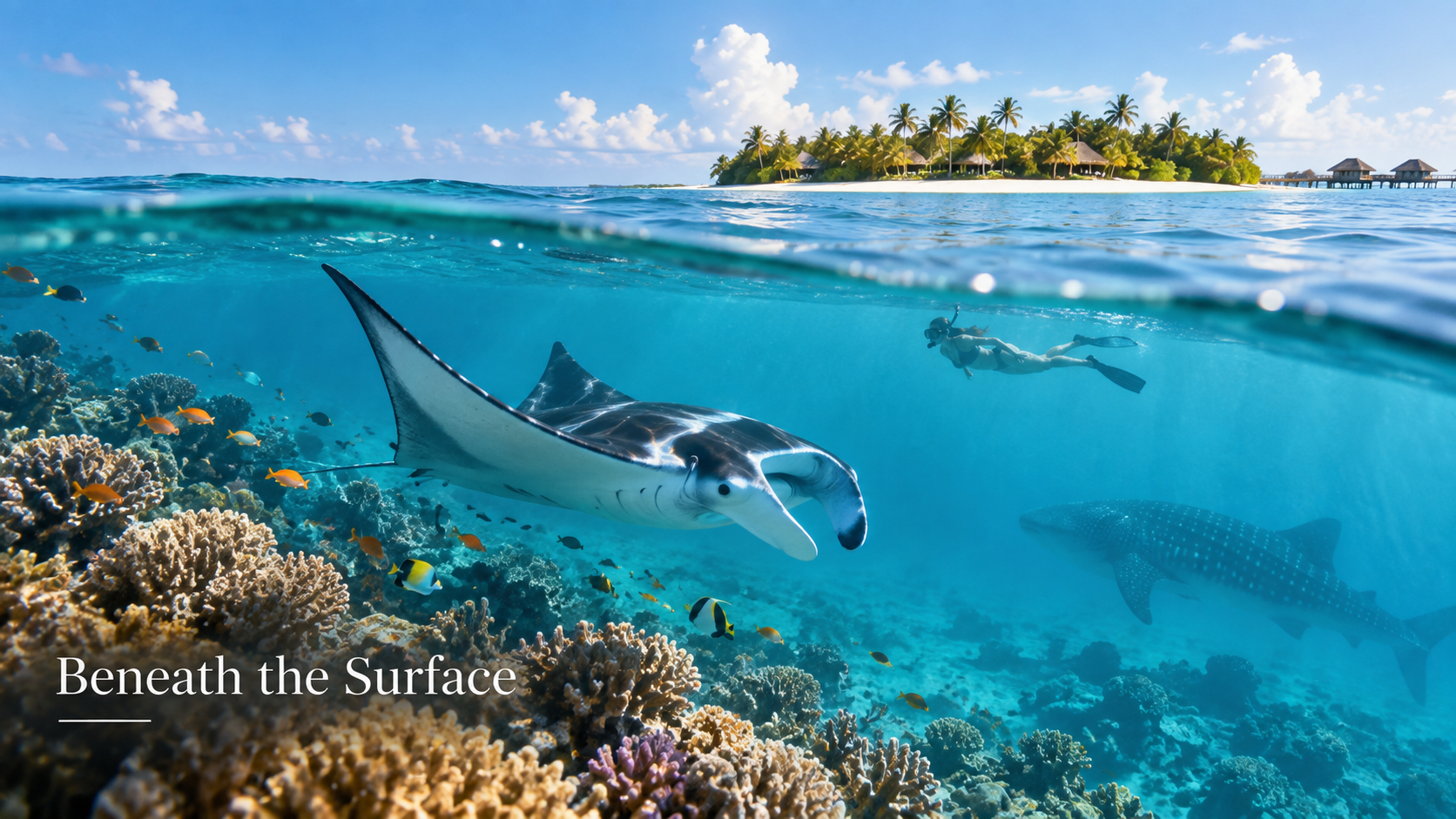
From the villa deck, every lagoon can look perfect. That is the trick. Two islands may both be surrounded by luminous blue water, yet what happens beneath that water can be completely different. One lagoon may be shallow and sandy for a long distance. Another may reach a reef edge where coral drops into deep blue and fish gather in astonishing numbers. If marine life is one of the reasons you are flying to the Maldives, choose the ocean before you choose the room. Start with the house reef A house reef is the reef associated with the island or resort, but the phrase alone tells you surprisingly little. The important question is access. Can you swim to good snorkelling directly from shore or from your villa? Is the reef edge close? Are there designated entry points? Do currents make some areas suitable only for confident swimmers? Does the resort regularly take guests by boat to better sites? For someone who wants to snorkel twice a day without arranging an excursion, these differences can matter more than another fifty square metres of villa space. Mantas follow food, not hotel calendars Manta rays are part of the magic of the Maldives precisely because they are wild. In Baa Atoll, Hanifaru Bay becomes famous during the southwest monsoon period when plankton can concentrate in the bay and draw feeding mantas. Visit Maldives identifies May to November as the broader season, with particularly notable activity around the middle months. Standing at the surface while a manta turns beneath you can alter your sense of scale. It seems less like watching an animal than watching a piece of the ocean itself move. But no responsible operator can promise the performance on a particular morning. Wildlife should be treated as possibility, not appointment. Whale sharks require the same patience The whale shark presents another delightful contradiction: the largest fish in the ocean can appear almost gentle enough to miss. South Ari Atoll is especially associated with whale-shark encounters, while Baa Atoll can also produce sightings around seasonal feeding conditions. Visit Maldives highlights both South Ari and Hanifaru Bay among important whale-shark areas. Choose an operator that treats the encounter as wildlife observation rather than pursuit. The quality of the experience depends as much on behaviour in the water as on whether an animal appears. A beautiful reef is not a swimming pool Premium travel sometimes creates the illusion that nature is another service that can be ordered. Coral reefs quietly reject that idea. Currents change. Visibility changes. Animals move. Weather reshapes the day. Some guests discover that the most extraordinary encounter of the week happens ten metres from the beach rather than on the expensive excursion they planned months earlier. That uncertainty is part of the wonder. Choose the resort around your real priority If marine life ranks high on your list, ask detailed questions before booking. Do not simply ask, “Is snorkelling good?” Ask where. Ask how you get there. Ask what is commonly seen. Ask about seasonal changes, guided house-reef tours, manta or whale-shark excursions, safety procedures and the resort’s marine-biology programme. You may discover that the island with the most spectacular villa is not the island with the most interesting water. And somewhere around the second or third snorkel, another change occurs. The Maldives stops looking like a collection of islands surrounded by sea. It begins to look like an ocean with islands scattered across its surface.