Travel Planning
How Many Nights Do You Really Need in the Maldives?
How long should you stay in the Maldives? This guide explores why four, seven or ten nights create different experiences, and how extra time can transform a beautiful holiday into something slower, deeper and memorable.
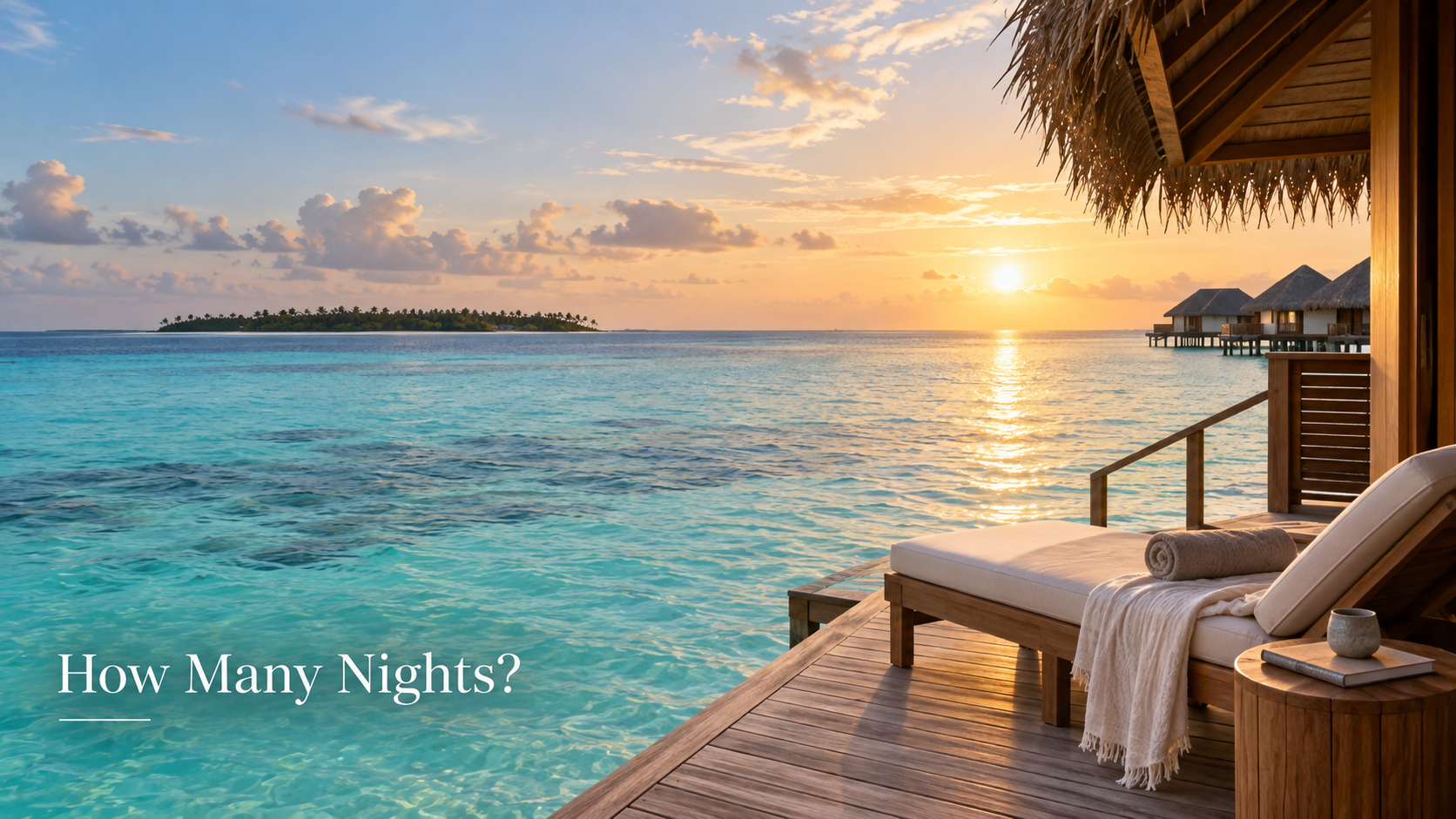
On the first morning, you are still arriving. Your body may be standing barefoot on a white beach, but some part of you is still in an airport lounge, a taxi, or the time zone you left behind. You photograph the lagoon. You learn the path to breakfast. You discover which side of the island catches the evening light. Then something changes. By the third morning, you stop checking the map. That small shift is why the question “How many nights do I need in the Maldives?” deserves some thought. Four nights can be beautiful — and very fast A short Maldives stay can work wonderfully, particularly when paired with another destination or when the resort is easily reached from the international airport. But count the journey honestly. Arrival day is rarely a complete resort day. Your departure day may also be shaped by transfer timing. A four-night booking can therefore feel considerably shorter than the number on the confirmation. If you have flown halfway around the world, too little time to settle in can be an odd trade. Around seven nights changes the rhythm A week gives the island room to unfold. There is time for the ambitious morning when you want to snorkel, paddleboard and explore everything. There is also time for the afternoon when doing absolutely nothing suddenly feels like an excellent plan. Interestingly, the wider Maldives tourism market has been moving close to a seven-night pattern. Our analysis of the Maldives’ average duration of stay found that the 2025 average was just under seven days. For a premium holiday, seven nights often creates a useful balance: long enough to decompress, short enough for the island still to feel special when you leave. Ten nights gives you permission to stop optimising This may be the real luxury. With ten nights, a rainy morning does not feel stolen. A missed snorkelling trip can move to another day. You can return to the same restaurant because you loved it instead of trying somewhere new simply because time is running out. Longer stays also make a split itinerary more sensible: perhaps five nights on a remote resort followed by four on another island with a different reef, atmosphere or style. The key is not to turn extra time into extra movement. Two resorts are not automatically better than one Island hopping sounds irresistible on a booking screen. In reality, every move has a cost measured in packing, check-out times, boats, aircraft, waiting and another round of orientation. For a seven-night holiday, changing resorts can divide one relaxing trip into two short stays. For ten nights or more, the equation changes. A second island can add genuine contrast if it offers something different: another atoll, a stronger house reef, a different style of accommodation or a more local experience. Stay until the island becomes familiar The Maldives is often sold through spectacle: the first aerial view, the first overwater villa, the first impossibly blue lagoon. But some of its best moments arrive after the spectacle softens. You begin recognising the heron near breakfast. You know when the beach is quiet. You stop photographing every sunset because you trust another one will come tomorrow. That is the point at which a holiday becomes a place. If your budget allows you to choose between a more elaborate room for five nights and a wonderful room on the right island for eight, do not assume the larger villa will create the richer memory. In the Maldives, time may be the most luxurious upgrade of all.