Food & Dining
All-Inclusive, Half Board or À La Carte? Choosing a…
Meal plans can quietly shape your Maldives holiday. Compare half board, all-inclusive and à la carte through the lens of freedom, convenience, dining variety and travel style, helping you choose the option that feels effortless.
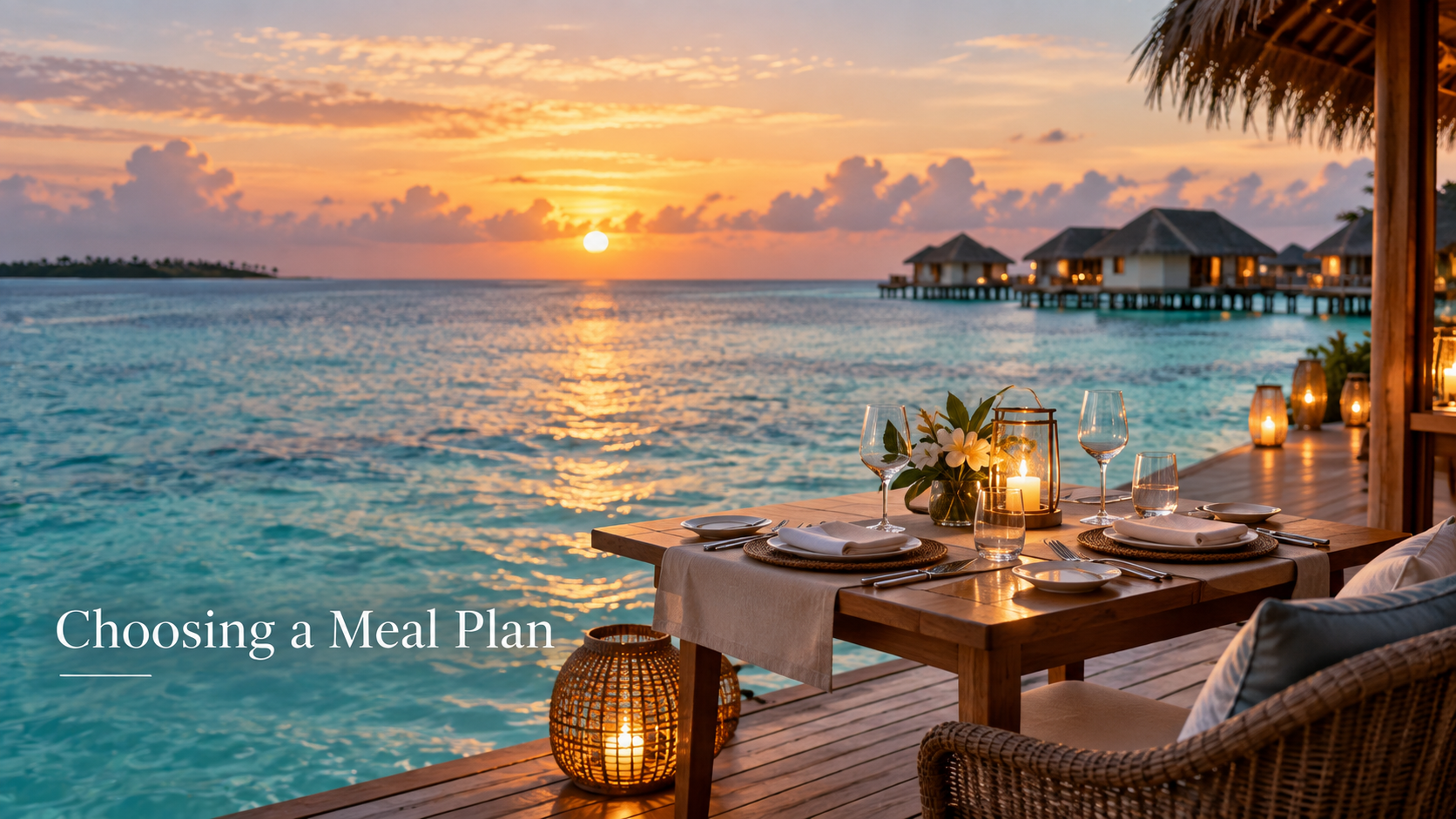
At breakfast on a Maldives island, the day looks wonderfully uncomplicated. The lagoon is bright. A boat is leaving for the reef. Someone is cutting mango. Dinner feels very far away. Then evening arrives and you discover that the question you barely noticed while booking — half board, full board, all-inclusive, dining credit, breakfast only — quietly shapes the way you experience the resort. The best meal plan is not necessarily the one containing the most things. It is the one that gives you the right balance of freedom and ease. Half board creates a simple daily rhythm Breakfast and dinner are taken care of. Lunch remains open. That structure works beautifully for travellers who spend the middle of the day diving, sailing, visiting the spa, or simply eating lightly by the pool. You begin and end the day with certainty without feeling that every meal must be consumed because it has already been purchased. At a resort with several restaurants, check exactly where the plan applies. “Dinner included” can mean broad choice or one designated restaurant with supplements elsewhere. The detail matters more than the label. All-inclusive is really about removing decisions There is a moment, often around day three, when some travellers grow tired of signing bills. A drink by the pool, lunch, another drink, dinner, wine, minibar, an excursion — none may be individually troubling, but each produces a tiny transaction. A well-designed all-inclusive plan removes much of that friction. Its appeal to an affluent traveller is therefore not necessarily saving money. It is creating a holiday in which fewer decisions have to pass through a calculator. But read the boundaries. Premium wines, speciality restaurants, private dining, spa treatments and certain activities may sit outside the package. Our article on how Maldives accommodation businesses design holiday packages explains an important principle from the operator’s side: a package is not simply a list of free items; it is a set of carefully defined boundaries. À la carte gives maximum freedom For travellers who regard food as part of the adventure, paying as you go can be liberating. You might have a long tasting-menu dinner one night and barely want lunch the next day. You may prefer the Japanese restaurant, return twice to the grill, or book a private sandbank dinner without worrying whether you are “using” your package correctly. This works particularly well at resorts where dining variety is itself one of the attractions. Look at the resort before the plan A small island with one main restaurant presents a different decision from a large resort with ten dining venues. Ask how many restaurants will actually operate during your stay, whether reservations are required, what the meal plan covers, whether beverages are included, and how private dining is treated. Families may value predictability. Wine enthusiasts may care about premium-beverage exclusions. Honeymooners may prefer flexibility. Divers may need meals that work around boat schedules. The best luxury is forgetting the mechanics There is no prestige hierarchy here. All-inclusive is not automatically more luxurious than breakfast-only, and à la carte is not automatically more sophisticated. The right plan is the one that disappears once you arrive. You should be thinking about where to swim before dinner, not whether ordering lunch has broken some invisible package rule. When the meal plan fits the way you travel, food returns to what it should have been all along: one of the pleasures of being on an island in the middle of the Indian Ocean.